
About Denison Child Care Services Newmarket
Our Centres
Denison Child Care was founded in 1994. Denison Child Care currently has facilities for infants, toddlers, and preschoolers at Dr. John M. Denison Secondary School and Stickwood Walker Child Care. Programs for children from kindergarten to the age of 12 are located in the Poplar Bank, Glen Cedar, Terry Fox, and Phoebe Gilman Public Schools. The centres are an integral part of the school and community.
The program focuses on both the child and the family, recognizing the value, worth and dignity of each individual. It is our intention to provide quality care for the children through the use of trained, qualified staff who provide a warm and stimulating environment geared to each child’s own interests, abilities, and needs. By developing competencies in working with their own and other children, our student parents will develop realistic expectations for children while earning credits toward their Secondary School Diploma.
The centres are a training facility, welcoming students from various community colleges, universities, and secondary schools.
Our Mission
Denison Child Care strives to provide a stimulating and nurturing inclusive environment that challenges and fosters a child’s curiosity of the world and potential for learning by engaging him/her through child-directed activities. The program focuses on both the child and the family, recognizing the value, worth and dignity of each individual.
Goals
Our goal at Denison Child Care is to provide a safe, stimulating, nurturing environment, balanced between active and quiet, indoor and outdoor experiences that will:
- Strengthen and develop the child’s learning potential and skills;
- Promotes health, safety, nutrition and well-being of the children;
- Foster and support children’s individual views of exploration, play and inquiry;
- Encourage independence and self-esteem through positive interaction with others;
- Encourage the child to explore and discover his/her world;
- Celebrate differences and similarities through an anti-bias approach;
- Meet the needs of the individual child, as well as those of the group;
- Maximize parent partnerships with the Centre and Staff through ongoing communication;
- Welcome visitors to the centre – parents with special skills, professionals;
- Capitalize on visits to local area of interests through various trips throughout the year;
- Encourage the participation of the community by providing placements for university, college and secondary school students in co-operative placements;
- Supports staff and others who interact with the children in relation to continuous professional learning; and
- To consistently review our approaches at Denison Child Care and to keep-up-to-date on any trends.

Pedagogy
Pedagogical Statement
Denison Child Care views children as being capable, competent, curious in nature and rich in potential. Safe and stimulating environments are crucial to enhancing a child’s full development. Our programs provide a combination of a stimulating and nurturing environment that focuses on opportunities for learning through a variety of hands-on, play-based experiences.
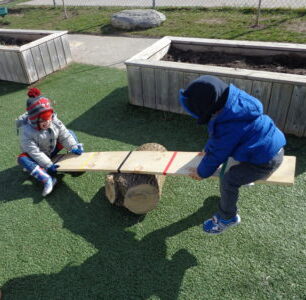
At Denison, we believe deeply in the value of play. During play, that includes times of outdoor and indoor, active play, rest and quiet time, children use their senses to discover and manipulate the things in their environment. They interact with other children and adults. They imitate and experiment with roles and means of expression. Consideration is given to the individual needs of the children. Through the exploration of their environment, children begin to form the concepts on which all future learning will be based.
The children in the program are encouraged to initiate their own activities as dictated by their personal needs and pace. During these self-chosen activities, children draw ideas from their own interests and imaginations. The children have the opportunity to improve their problem-solving skills, as well as gain a sense of self-responsibility as a result of having a wide variety of choice in their activities. Throughout this process, their self-confidence will increase and flourish. In addition, the program staff are trained in facilitating and expanding upon the individual child’s interests when providing materials and activities, creating an environment that is appropriate for his or her developmental needs. These dimensions of the learning environment ensure the growth of each child physically, cognitively, socially, emotionally and creatively. The environment will be viewed and supported as a third teacher to help create a positive learning environment.
In the spirit of co-operation on which the centre is based, families and teachers work together as responsible role models reflecting warmth, consideration, and respectfulness. The continuity between home and child care helps to ensure an atmosphere of acceptance and care. Working together, we can create an environment in which the children not only learn, but also develop a love of learning. It is our aim to provide an atmosphere in which children feel free, safe and comfortable to follow their urges to explore, discover, learn and thrive.
We encourage the children to learn to be responsible for their own behaviour, self-regulate their emotions and communicate in a positive way. When appropriate, we expect them to solve their own problems, with the assurance that there is an adult present for support if it is needed. There is immediate adult intervention if destructive behaviour is exhibited by any child against self, another child, staff members or equipment.
We practice positive child guidance strategies. We believe, however, that it is impossible to create a warm and secure atmosphere if the environment is punitive. We place the emphasis on understanding the individual child and the reasons for the inappropriate behaviour. It is therefore, our responsibility to locate the source of that inappropriate behaviour, understand it, and help to change it.
The most effective means of producing more appropriate behaviour is through modelling, explanations, redirection, and presenting alternatives. Our focus is to bring the children to a level at which they understand their own individual needs and are able to express emotions and direct themselves appropriately.
Denison Child Care provides an anti-bias approach in program development that promotes equal respect and acceptance for all. Differences are GOOD; they exist and are be enriching. As children are exposed to diversity in all programming areas it teaches the acceptance of these differences. As a result, children grow to be more tolerant.
Staff members are to work closely with families to provide cultural consistency in harmony with the home. This promotes an atmosphere that encourages openness to the perspectives of others.
At Denison Child Care Centre, the programs are re-evaluated regularly to reflect changes within the Child Care and Early Years Act, 2014 and ideologies on Early Childhood Education. Staff members use the principles found in ‘How Does Learning Happen?’; ‘Think Feel Act’; and the ‘Early Learning for Every Child Today’ to provide the foundation for curriculum planning and guidance. In addition, the learning is made visible to families through the documentation created by the children and trained staff. The Standards of Practice as found in the College of Early Childhood Educators Code of Ethics guides our professionalism.
Behavioural Philosophy & Positive Interactions
All Centre employees are prohibited from the following practices under the Child Care and Early Years Act:
- Corporal punishment (physical punishment such as hitting, spanking, kicking, heavy pushing, shoving, grabbing, squeezing arms, ears, etc.);
- Physical restraint of the child, such as confining the child to a high chair, car seat, stroller or other device for the purposes of discipline or in lieu of supervision, unless the physical restraint is for the purpose of preventing a child form hurting himself, herself, or someone else, and is used only as a last resort and only until the risk of injury is no longer imminent;
- Locking the exits of the Centre for the purpose of confining the child, unless such confinement occurs during an emergency and is required as part of the licensee’s emergency management policies and procedures or using a locked or lockable room or structure to confine the child if he or she has been separated from other children;
- Use of harsh or degrading measures or threats or use of derogatory language directed at or used in the presence of a child that would humiliate, shame or frighten the child or undermine his or her self-respect, dignity or self-worth;
- Depriving the child of basic needs (i.e. food, drink, shelter, clothing, toilet use, sleep and bedding). Food should not be used to discipline children at lunch or snack time;
- Inflicting any bodily harm on children, including making children eat or drink against their will.
Corporal punishment and other harmful disciplinary practices are forbidden in order to protect the emotional and physical well-being of children. These practices are never permitted at the Centre. Children benefit from an affirming approach that encourages positive interactions with other children and with adults, rather than from a negative or punitive approach to managing unwanted behaviour.
POSITIVE SOCIAL INTERACTION
In accordance with the Centre’s program statement and the Child Care and Early Years Act, the Centre will support positive interactions between children, families, staff and the community, rather than “managing” a child’s behaviour. Research has shown that children who attend programs where they experience warm, supportive relationships are happier, less anxious and more motivated to learn than those who do not. Further, by responding positively to children’s cues and engaging in reciprocal interactions with them, we are supporting the development of secure relationships. Experiencing positive relationships in early childhood also has significant long-term impacts on physical and mental health, and success in school and beyond.
In using a positive approach to guide children, employees should use the following methods in their interactions with children in order to establish and maintain positive interactions:
- Positive role-modelling by demonstrating appropriate ways of interacting.
- Providing logical consequences for behaviour.
- Using a calm voice.
- Providing consistent messaging to children.
- Speaking at children’s level.
- Asking for assistance when required.
- Following through on agreed-upon messages.
- Redirecting to appropriate activities or behaviours.
- Providing opportunities for self-regulation by outlining appropriate choices for children and supporting a child’s ability to gain control.
- Adhering to Denison Child Care Centre’s program statement and philosophy.
Rather than reprimanding children for undesirable behaviours, Employees should assist the child in finding new ways to achieve their goals. For example:
- Look for the root cause of behaviour.
- Reduce stressors.
- Support children’s efforts to initiate and join in play with others.
- Acknowledge that each child is competent, curious and rich in potential.
- Give choice whenever and wherever possible.
- Notice, acknowledge and document positive interactions and attempts at self-regulation,
and share this information with the child and family to gain insight.
Remember at all times that a child should feel a sense of belonging among children, adults and the world around them.
DE-ESCALATING VOLATILE SITUATIONS
In spite of the limits that you set, difficult situations will arise.
- Remain alert to the total situation. Attempt to foresee and forestall trouble. Redirect an uncooperative child to another activity. Redirect the entire activity into a more wholesome direction.
- Allow children of comparable size and ability to work out their own solutions. Encourage the shy child to stand up for him/herself. Encourage the aggressive child to verbalize.
- Help children understand one another’s actions.
- Treat toilet accidents casually.
- Try to ignore improper language. Say “We talk nicely here”.
- Do not allow a child to strike you. Gently say, “I don’t like to be hit”.
- If one child requires too much adult attention, he or she should be temporarily removed from the group. Do so gently without punitive action. Your purpose is to help him or her.
GIVING DIRECTIONS
- Be sure you have the child’s attention. Make eye contact. Get down to the child’s level.
- Give positive directions that leaves the child no choice of interpretation.
- Give a choice of two things when possible.
- Warn ahead of time before changing activity.
- Never plead, threaten or strike.
- Invite participation.
- Direct the child to a new activity when the present activity is completed.
- Use a quiet voice as much as possible. Get down to the child’s level when talking with him or her.
PROFESSIONAL ATTITUDES
- Never discuss a child when another child is present.
- Never discuss a child within his or her hearing.
- Do not discuss one parent’s handling of a situation with another parent.
- Please do not talk among yourselves in the classroom or playground.
- Do not, at any time, leave children unsupervised, either indoors or outdoors, even for a few minutes.
Program Diversity
Denison Child Care provides an anti-bias approach in program development that promotes equal respect and acceptance for all. Differences are GOOD; they exist and can be enriching. As children are exposed to diversity in all programming areas it teaches the acceptance of these differences. As a result, children grow to be more tolerant. Our staff is trained to work closely with families to provide cultural consistency in harmony with the home. This promotes an atmosphere that encourages openness to the perspectives of others
Inclusion of Children with Special Needs
Denison Child Care programs are open to all children. We will continue to train and support all staff consulting the expertise from outside agencies such as Blue Hills, the C.N.I.B. and Early Intervention Services to provide programs based on the needs of the child and the family. It is our intention to work closely with families to provide support based on a family’s unique needs and expectations. We are willing to make changes to the program and/or space to accommodate the physical needs of a child with special needs.
Field Trips
Various trips are taken by the children throughout the year to places of special interest. Detailed information about the trip will be sent home prior to such excursions. Trips are an integral part of the program. If for some reason parents do not wish for their child to participate, alternate arrangements for your child’s care must be made. There is no reduction in fees for an absence due to non-participation. Parent volunteers are always welcome to join their child on an outing.
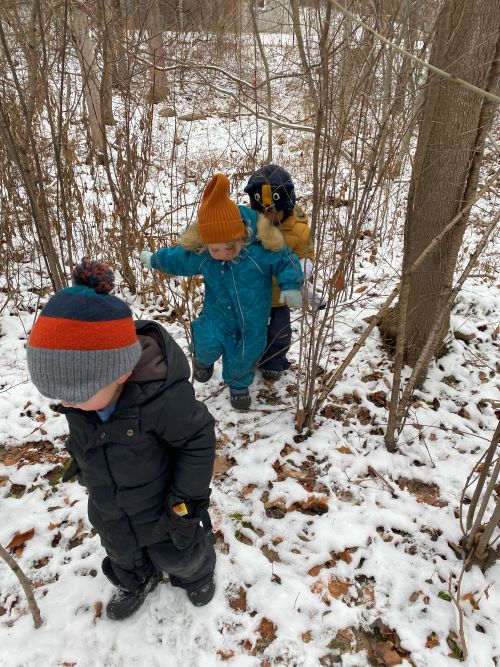
Denison Child Care takes advantage of outdoor learning and experiences by planning field trips in all four seasons of the year. Staff are trained to follow Public Health guidelines and provide a safe and healthy experience in all weather conditions. Children should come prepared to benefit from the outdoor experiences for each individualized trip.
Parent Involvement
Individual interviews, group meetings, and workshops supplement daily contact between parents and staff. Family members are encouraged to participate in the daily program and to visit their child in their free time.
The Board of Directors encourages all staff and parents to attend the bi-monthly board meetings. Interested parents are encouraged to join the Board of Directors.
Community Involvement
- Local visits – fire station, library, police station
- Visitors to the centre – parents with special skills, professionals
- Regular involvement from students at the adjacent school
- Visitors from other child care programs and organizations to share information
- Placements of Early Childhood Education students from local colleges and universities, as well as co-operative education students from high schools.